
New White Paper Offers Options to Manage the Cash Cycle Better
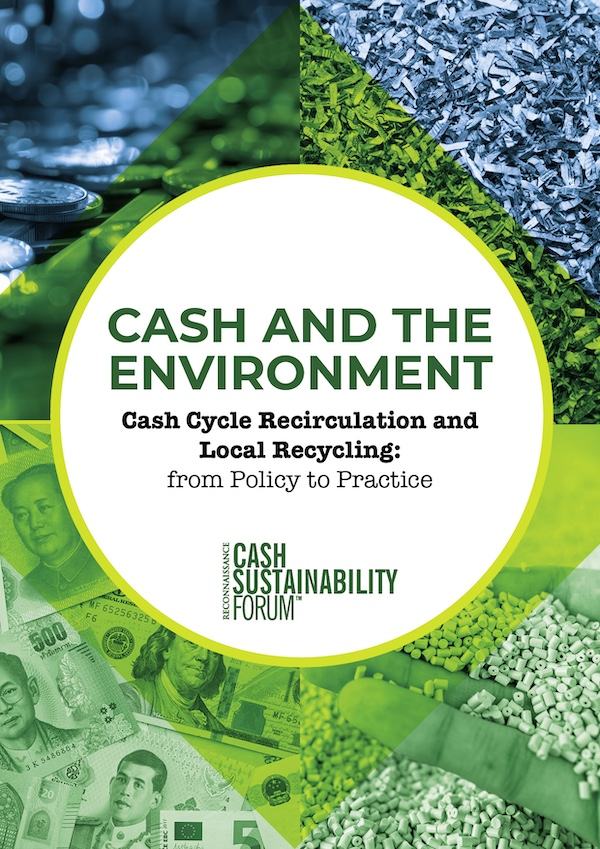
A new white paper investigates how cash management is changing and best practice for optimising efficiency, thereby reducing the cost and environmental impact of cash. The white paper is free to download and is available at https://reconnaissance.net/cash-and-the-environment/.
Written by Reconnaissance International and The Blond Group, with help from the ATM Industry Association, the paper focuses on what happens to cash once it has been issued, because that is where the majority of the environmental impact of cash occurs. It draws on interviews and research with 24 organisations from five continents and every stakeholder involved in the cash cycle to offer case studies and examples of what is being done and to what effect. .
What is changing?
Recognising that every country is different, the paper is not prescriptive but offers options and alternatives through a structured approach. The paper starts by considering what is changing and why the paper is needed ). It touches on who should lead when it comes to sustainability and argues that although central banks have both direct and indirect levers of control, in reality, all can play their part. .
Inevitably the cost of the cash cycle is at the heart of these chapters. Different business models, and therefore different cost structures, apply depending on how much is done by the central bank and how much has been outsourced. As payment behaviour changes, so does the profitability of providing cash services.
Levers of control
Central banks can use regulations and penalties, and offer incentives, as part of their tool kit of cash management options . Off-balance sheet arrangements in particular are a useful tool used by some banks, and perhaps with the option of extended use in the future.
The rise of recycling
Cash handling technology is also changing the cash cycle . Some is still in its infancy, but automation is now well established and being increasingly adopted along with better collection and analysis of data as a response to cost pressures, fewer bank branches, more co-ordinated cash management and more. The result is more cash recycling outside of cash centres and even bank branches, making cash usage and cash management more remote from the traditional central bank levers of control.
Learning from others
The paper ends with two chapters dedicated to case studies. First is a chapter with country case studies considering central bank initiatives. Second is a series of industry case studies to understand what cash management companies are doing.
A series of Annexes provide details about everything from banknote design optimisation, getting ATMs to net zero, different central bank cash cycle models and how they have been decentralised, central bank off balance sheet relief scheme options and recycling legislation approaches.
Pause and reflect
At the very start of the paper, immediately after the Executive Summary, is half a page with four bullet points of actions which will have the biggest impact. If you are short of time or want a first status check of your own work, start there!
Otherwise, this is an attempt to capture a change (namely payment behaviour), see the impact on existing business models and to consider the challenges this can bring, and to invite you to compare and contrast your position with some of the cash handling models that exist. It offers changes being made by some central banks and cash industry players and shows how some are changing the levers of control in response to change.
Note to Editors:
John Winchcombe
John Winchcombe has worked with central banks on the design, issue and circulation of banknotes from joining De La Rue in 1988 to today. His De La Rue career included working in banknote paper mill and print works, responsibility for new product development of paper, polymer, print, machine readable and optical features for banknotes and marketing strategy. John’s last job at De La Rue involved four years as Line of Business Director for the Currency business.
In 2016, after leaving De La Rue, John worked for CCL Secure and in 2018 he started work as a consultant, firstly for 7 Layer Solutions and then also with Reconnaissance International.
John’s work for Reconnaissance is to bring his knowledge of central banks, banknote manufacture, banknotes and the entire cash cycle into the business, including putting this into the wider payment context as alternative and digital payment methods develop and grow in popularity.
Paul Blond
Paul Blond is Managing Partner of specialist currency and payments advisory firm The Blond Group LLP. With a background in retail and private banking, Paul has worked across the currency and payments industry around the world for more than 30 years.
Working closely with many central banks, banking associations, commercial banks, cash logistics companies and other cash and payment stakeholders, Paul has an in-depth understanding of global cash and payments issues past, present, and emerging.
Paul has successfully completed a wide range of strategic and operational assignments that have ranged from advising central banks on currency recirculation policies and national cash and payments strategies, through to the end-to-end multi-year delivery of a new currency series rollout for Australia’s largest commercial banking group.
Paul frequently contributes to industry thought leadership work and is a regular presenter at industry conferences.
ATMIA
ATMIA is a non-profit trade association representing the entire global ATM industry, covering the entire ATM ecosphere, including financial institutions, independent ATM deployers, equipment manufacturers, processors, and a plethora of ATM service and value-added solution providers.
The mission of ATMIA is to promote ATM convenience, growth and usage worldwide; to protect the ATM industry’s assets, interests, good name and public trust; and to provide education, best practices, political voice and networking opportunities for member organizations.